Scuba diving isn’t a reward trip. It’s a science lab that happens to be underwater.
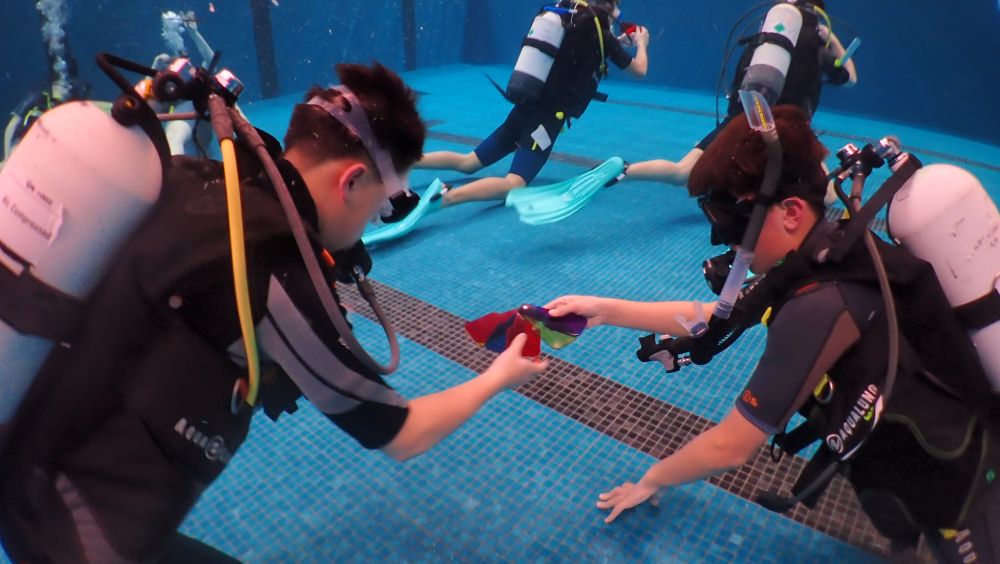
When we take a group of students into the water, STEM stops being abstract.
Boyle’s Law becomes something they feel in their lungs at 2 metres. Newton’s Third Law explains why they move when they push water with a fin.
Marine biology shifts from a textbook chapter to a live ecosystem they are literally inside.
That’s the difference between learning about science and doing it.
Oyster Diving has been running PADI courses and diving travel for over 20 years. We work with schools and colleges across the UK, and we build programmes around your curriculum needs, whether that’s a single pool session or a full end-of-year overseas expedition.
Every UK scuba session is delivered by our qualified PADI instructors, all DBS-checked and experienced working with young people.
Why scuba diving works so well for STEM
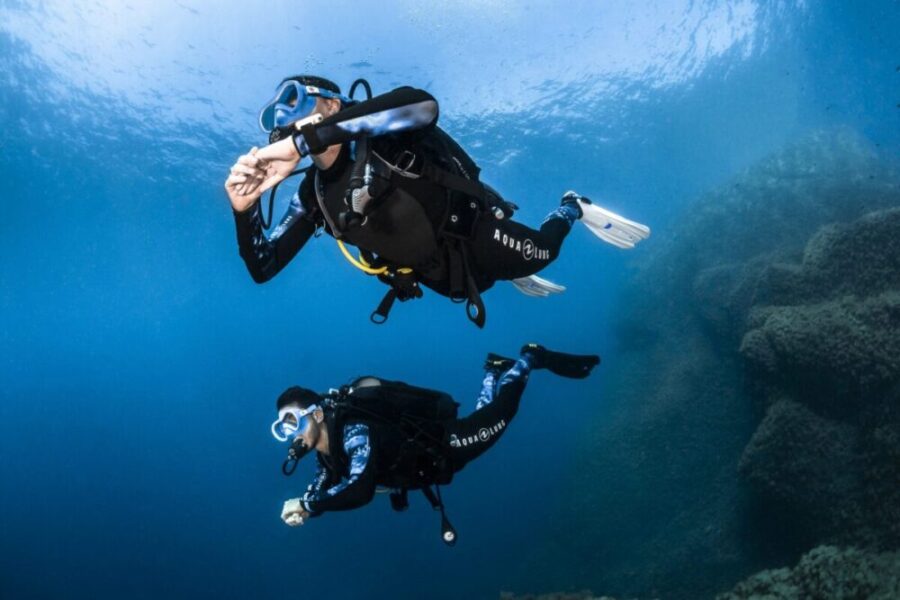
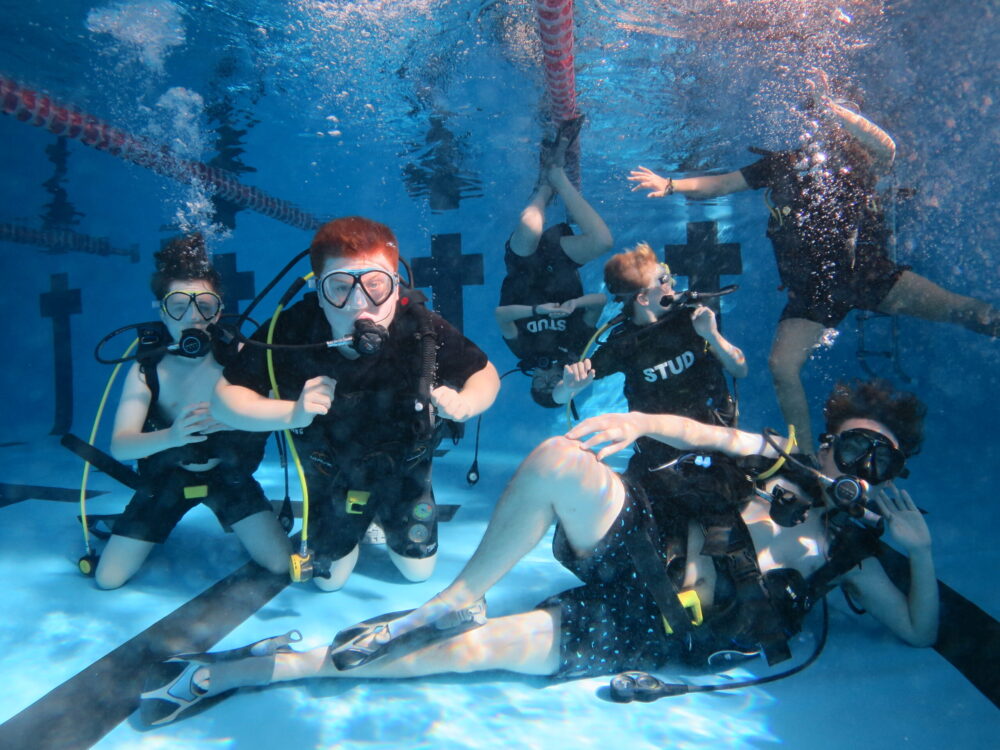
The underwater environment is one of the richest STEM classrooms available. It brings together physics, biology, chemistry, technology, and engineering in a way no classroom can replicate, and it does so in a context students genuinely want to engage with.
Physics
The pressure changes students experience on even a shallow dive make Boyle’s Law and Dalton’s Law immediately tangible. Buoyancy and Archimedes’ Principle shift from exam definitions into something students actively manage with their BCD and breath control. Light refraction, sound transmission, and thermoclines all present as observable phenomena rather than diagrams on a slide.
Biology
Marine ecosystems, food chains, organism adaptation, and the physiological effects of pressure on the human body are all covered within the PADI curriculum. Students studying marine biology or environmental science see the theory in action on every dive. A PADI Underwater Naturalist specialty takes this further, with structured species identification and habitat observation techniques that map directly onto fieldwork skills assessed at GCSE and A-level.
Chemistry
Ocean acidification, dissolved oxygen levels, water temperature, and salinity all connect directly to GCSE and A-level Chemistry units. We can incorporate water sampling and basic field analysis into our open water sessions for groups that want to go further.
Technology and engineering
Dive computers, pressure gauges, underwater torches, rebreathers, and remotely operated vehicles (ROVs) are all live examples of technology solving real engineering problems. Students studying BTEC Engineering or A-level Physics will find plenty to interrogate. Every piece of scuba equipment is a design solution to an engineering constraint, and we treat it as such in our briefings.
Problem-solving under pressure
Mask clearing, regulator recovery, and controlled ascent aren’t just safety drills. They are structured problem-solving under mild stress. The PADI approach to skills training builds exactly the kind of methodical, safety-conscious mindset that STEM employers look for, and that employers increasingly say school leavers lack.
Scuba diving can be a powerful gateway into STEM: one SCUBA-based youth programme reported that 100% of participants developed greater interest in science and a better understanding of STEM career opportunities after taking part in diving, marine science, robotics and conservation activities (source: The Journal of Marine Education). We’ve seen it ourselves: students who struggle with abstract theory in a classroom will troubleshoot a buoyancy problem instinctively the moment they’re in the water.
How scuba diving maps to the UK STEM curriculum
| Subject | Topic | Key Stage / Level | Diving connection |
|---|---|---|---|
| Physics | Pressure and forces | KS3, GCSE, A-level | Boyle’s Law, Archimedes’ Principle, buoyancy management |
| Physics | Waves: light and sound | GCSE, A-level | Light refraction underwater, sound transmission, thermoclines |
| Biology | Ecosystems and interdependence | KS3, GCSE, A-level | Coral reef and marine ecosystem observation, food chains |
| Biology | Adaptation and physiology | GCSE, A-level | Organism adaptation, physiological effects of pressure |
| Chemistry | Quantitative chemistry / Earth’s resources | GCSE | Dissolved oxygen, salinity, ocean acidification |
| Environmental Science | Biodiversity and conservation | A-level, BTEC | Species logging, habitat mapping, reef health assessment |
| Engineering / Technology | Design and systems | BTEC, A-level | Dive computers, regulators, ROVs, gas management systems |
| Geography | Physical environments / fieldwork | GCSE, A-level | Water temperature, ocean systems, marine habitat surveys |
STEM scuba diving activities we can run for your group
We design sessions around your students’ age, experience, and curriculum context. These are the activity formats we run most often, but we’re happy to build something more specific around a particular unit or assessment objective.
If you want to run your own activities we can train your Teachers and then act as Instructors to the students and safety divers.
Discover Scuba pool sessions with physics integration
A two-hour pool session at one of our pools, or your school pool, combined with a pre-dive briefing that maps the experience to specific physics concepts: pressure, buoyancy, and gas laws. Students try scuba under direct instructor supervision at a depth of no more than 3 metres, then debrief with a structured worksheet or group discussion linking what they felt to the underpinning theory.
Suitable for ages 10 and above. No prior swimming qualification required, though students should be comfortable in water. Group size is a maximum of 12 students per session, with a 1:6 instructor-to-student ratio in the water.
Marine biology workshops combining classroom and pool or open water
We combine classroom content, delivered by our instructors or your own teachers, with a pool or open water session focused on species identification, ecosystem structure, and underwater observation techniques. Students practise naturalist skills – approach, observation, recording – and complete species logs from their dives.
LocationsParticularly well-suited to GCSE and A-level Biology, Environmental Science, and Geography groups. Can be run at our pool sites in London or at UK open water sites including Mercers Lake in Surrey for groups that want a genuine freshwater ecosystem to study.
Underwater photography and scientific data collection
Students use underwater cameras or Gopro’s, or your school’s equipment to document what they observe. The resulting images feed a post-dive analysis session covering species identification, habitat mapping, and diversity recording. This works well as a paired activity: one student dives, one observes from the surface or poolside and records data in real time.
The photography component keeps non-diving students active and engaged. The data analysis back in school extends the learning day well beyond the dive itself, and the outputs can be used directly in coursework or extended project write-ups.
ROV and diving technology exploration sessions
For groups focused on engineering and technology, we build sessions around underwater ROV operation and the science behind diving equipment. Students examine how dive computers process depth and time data, how rebreathers recycle breathing gas, and how professional diving equipment is engineered to solve real-world problems at depth. No in-water experience is needed for the ROV elements, making this accessible for groups where not all students want to dive.
Pressure and buoyancy experiments
A structured, lab-style session using pool equipment to explore Archimedes’ Principle, positive and negative buoyancy, and the effects of depth on air volume. Students run controlled experiments with weighted objects and observe how trained divers achieve and maintain neutral buoyancy. Connects directly to GCSE Physics units on forces and pressure, and can be run as a standalone session or as preparation for a full Discover Scuba experience.
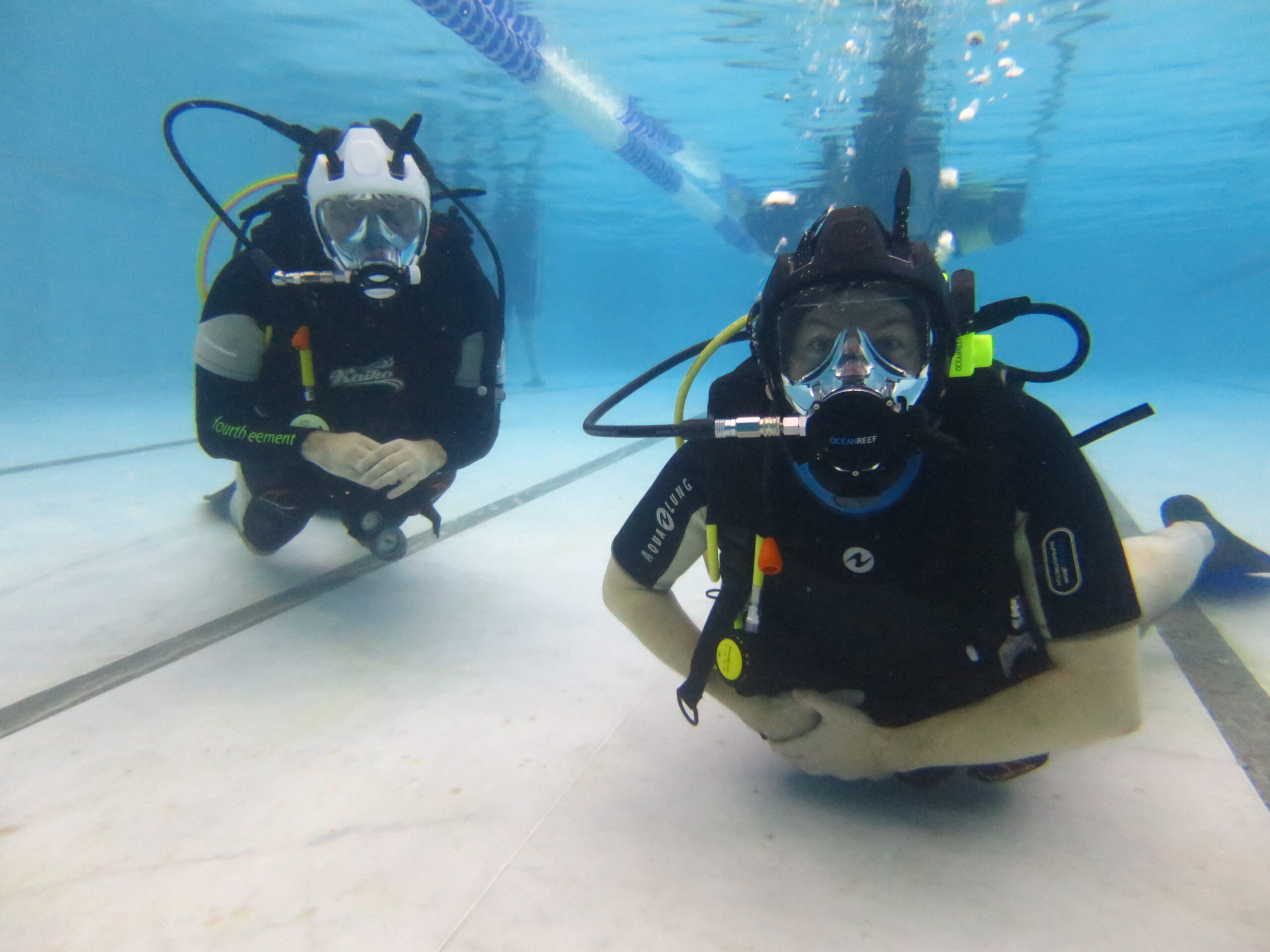
PADI diving courses for schools and colleges
If your school or college wants to go beyond a one-off session and give students a recognised qualification, these are the PADI courses we recommend. All can be structured to fit around a school term, half-term break, or condensed into a weekend programme.
PADI Bubblemaker (ages 8 and above)
A single pool session where students experience scuba breathing for the first time in water no deeper than 2 metres. This is the introductory activity we use most often for school groups: low risk, straightforward to organise, and consistently engaging for students who’ve never breathed underwater before. Students leave with a PADI Bubblemaker certificate on the day.
It’s also the most practical way to introduce a large cohort to scuba. We can run multiple Bubblemaker sessions in a single school day, rotating groups through while the rest of the class takes part in theory activities or species identification workshops.
PADI Seal Team (ages 8 to 12)
PADI’s structured pool programme for younger students. Seal Team works through a series of “AquaMissions” covering buoyancy, navigation, photography, and other core scuba skills in a game-based, mission-driven format. Each AquaMission can be linked to a specific STEM topic, and students earn a mission patch at each stage. The right starting point for primary and lower secondary groups, and it builds directly towards full certification when students are older.
PADI Open Water Diver (ages 12 and above)
The PADI Open Water course is the entry-level PADI certification, available to students aged 12 and above. Consists of eLearning, pool sessions, and four open water qualification dives. Students certify to 18 metres on completion (or 12m for under 13’s).
For sixth form and further education colleges, this is the course that makes the most sense. Students leave with a globally recognised PADI Open Water certification that can be used on any dive operation anywhere in the world. It also serves as the prerequisite for the Advanced Open Water and every Specialty course, so it is a meaningful qualification to hold.
PADI Advanced Open Water Diver
For students who already hold an Open Water certification and want to develop further. The PADI Advanced Open Water course comprises five Adventure Dives. Two are mandatory: Peak Performance Buoyancy and Underwater Navigation. Students then choose three from a list that includes Underwater Photography, Fish Identification, Search and Recovery, Deep Adventure, and others. Each of the available dives maps directly to a STEM subject area, and we frame the pre-dive briefings explicitly around that curriculum connection.
PADI Specialty courses with direct STEM links
For groups or individual students who want to target a specific subject area, PADI Specialty courses offer a focused, single-topic qualification. The four most relevant to STEM programmes are:
PADI Underwater Naturalist — structured marine biology and ecosystem observation skills. Directly relevant to Biology and Environmental Science curricula at GCSE and A-level. Students develop identification and recording techniques used by professional marine biologists.
PADI Underwater Photographer — technology, optics, and scientific data capture. Students learn how light behaves underwater, how to configure camera settings for different depth and visibility conditions, and how to build a systematic photographic record of a marine habitat.
PADI Search and Recovery Diver — underwater navigation, systematic search patterns, and the physics of working with submerged objects. A direct connection to engineering, mathematics, and technology units.
PADI Peak Performance Buoyancy — the physics of neutral buoyancy applied in practice. A natural single-session follow-on from a GCSE Physics pressure and forces unit, and one of the most satisfying courses for students who have recently studied Archimedes’ Principle in the classroom.
Scuba diving trips that reinforce STEM learning
The most effective STEM programmes we run don’t stop at the pool or the local lake. A group that has built the theory in a classroom, applied it at a UK dive site, and then dives in a genuinely biodiverse marine environment retains far more and develops a depth of understanding that is very difficult to achieve in any other way.
These are the destinations we recommend most often for school and college groups. All of our group diving holidays include full logistical support, risk assessments, and instructor coverage.
Malta and Gozo: the best first overseas scuba trip for student groups
Malta is our top recommendation for groups travelling overseas for the first time. Visibility regularly exceeds 20 metres, water temperatures are warm enough in summer to dive in a 3mm wetsuit, and the marine life is genuinely varied. The dive sites are well-managed and appropriate for newer divers, with most sites accessible from the shore.
For STEM purposes, the Maltese reefs offer excellent marine biology observation. Posidonia seagrass beds, octopus, moray eel, cuttlefish, and a good range of reef fish are all reliably seen. The wreck of the Um El Faroud off Wied iz-Zurrieq is suitable for more advanced student divers and provides a concrete example of an artificial reef developing over a sunken structure, which works well as a discussion point for ecology and habitat modules.
Logistics are straightforward. Direct flights from most UK airports, half-board accommodation at established dive-friendly hotels, and an infrastructure well used to handling school-age groups. We have taken multiple school groups to Malta and Gozo and the organisation is smooth. It is typically the lowest-cost overseas option for UK schools.
Red Sea, Egypt: coral reef science and marine biodiversity
For groups where the biology curriculum is the primary driver, the Red Sea is difficult to beat. Water clarity and coral coverage mean students can observe a functioning tropical reef ecosystem in conditions that allow good visibility for photography and identification work. Species count per dive is consistently high, which makes the Red Sea particularly well-suited to biodiversity and food chain studies.
Hurghada and Sharm el Shiekh are both practical bases for school groups. The dive sites around Abu Dabbab offer reliable access to reef turtles and dugong, organisms that bring marine biology to life in a way no documentary quite achieves. More advanced student divers can access sites with reef shark and larger pelagic species.
We build a structured observation programme into every Red Sea school trip: students complete species logs, habitat maps, and water quality assessments using field testing kits on each dive. The data can be brought back to school and used directly in coursework or class presentations. This kind of primary field data collection, gathered in a real ecosystem, is something examiners notice at A-level and in EPQ submissions.
Liveaboard expeditions for sixth forms and colleges
For sixth forms, colleges, or schools running a Duke of Edinburgh’s Award or Extended Project Qualification with a marine science theme, a liveaboard expedition raises the educational value considerably. Living on a dive boat for a week, completing three or four dives per day across different site types, and working through a structured data collection programme produces a quality of field experience that genuinely underpins academic work.
We run liveaboard trips in the Red Sea, the Maldives, and Indonesia. The Maldives offers a combination of coral reef, open-water pelagic, and deep-water observation that covers a wide range of ecosystem types in a single trip, which makes it particularly strong for groups working on biodiversity or climate change-related extended projects.
All students need to hold at minimum a PADI Open Water certification before joining a liveaboard. That is another reason to run the certification programme during the school year ahead of the expedition, with the trip serving as the capstone experience.
Frequently asked questions about scuba diving STEM programmes
What age do students need to be to join a STEM scuba session?
Students aged 8 and above can take part in a PADI Bubblemaker pool session. The PADI Junior Open Water Diver course is open to students aged 10 to 14. The full PADI Open Water Diver course is available from age 15. For Discover Scuba STEM sessions with physics integration, we recommend a minimum age of 10.
Do students need a swimming qualification for scuba diving?
No swimming qualification is required for pool-based sessions or the PADI Bubblemaker. Students should be comfortable in water. For the PADI Open Water Diver course, students must be able to swim 200 metres and float or tread water for 10 minutes. Our instructors assess water confidence at the start of every session.
How does scuba diving link to the GCSE and A-level curriculum?
Physics: Boyle’s Law, Dalton’s Law, Archimedes’ Principle, forces, pressure, light refraction, and sound transmission. Biology: marine ecosystems, food chains, organism adaptation, and physiological effects of pressure. Chemistry: ocean acidification, dissolved oxygen, water temperature, and salinity. Environmental Science and Geography: coral reef ecology, biodiversity, and habitat mapping. See the curriculum table above for a full breakdown by subject and key stage.
Are Oyster Diving instructors DBS-checked for school group work?
Yes. Every Oyster Diving instructor working with school and college groups holds a current Enhanced DBS check. We produce risk assessments and safeguarding documentation as standard for all group bookings.
Can you come to our school’s swimming pool?
In most cases, yes. We can bring equipment to an on-site pool if it meets minimum depth and size requirements for safe scuba use. Call us on 0800 699 0243 with your pool dimensions and we will confirm suitability usually within 24 hours.
Malta or the Red Sea — which is better for a school diving trip?
Both work well for different priorities. Malta is our top pick for first overseas trips: easy UK logistics, warm clear water, and good biodiversity at a lower cost. The Red Sea is the stronger choice when biology and coral reef science are the main curriculum focus, with higher species counts and better coral coverage. We’re happy to advise on the right destination once we know your group’s age range, certification level, and curriculum objectives.
What PADI courses can students take as part of a school STEM programme?
PADI Bubblemaker (ages 8+, pool, one session), PADI Seal Team (ages 8 to 12, pool programme), PADI Junior Open Water Diver (ages 10 to 14, full certification to 12 metres), PADI Open Water Diver (ages 15+, full certification to 18 metres), PADI Advanced Open Water Diver (for existing Open Water holders), and STEM-linked Specialty courses including Underwater Naturalist, Underwater Photographer, Search and Recovery, and Peak Performance Buoyancy.
How to book a STEM scuba diving programme
Call us on 0800 699 0243 or email info@oysterdiving.com. Tell us the age range of your students, approximate group size, your curriculum context, and whether you’re thinking pool sessions, open water, or overseas travel. We’ll come back with a programme proposal and a full cost breakdown, usually within two working days.
We handle safeguarding documentation, risk assessments, and instructor ratios as standard. As a PADI 5-Star Dive Centre, our training standards are independently audited. Every instructor who works with school groups holds a current Enhanced DBS check.
If you’d rather discuss it in person first, we cover pool sites across London and dive sites across the South East. We’re happy to come in to your school or college to talk through the options with your STEM department, trip coordinator, or head of year.